Clinical trials are the backbone of modern medicine but they are also slow, expensive, and increasingly weighed by the sheer volume of data they generate. AI in clinical trials is changing that. From patient recruitment to data anonymization to regulatory document writing, AI is being woven into nearly every stage of the clinical trial lifecycle.
This guide breaks down what AI in clinical trials actually means, where it’s delivering real value today, the risks and challenges that come with it, and what the next few years are likely to bring along with how purpose-built AI software, like GENINVO’s, is helping life sciences companies put these capabilities to work.
What Is AI in Clinical Trials?
AI in clinical trials refers to the use of machine learning, natural language processing, and related technologies to support the design, conduct, analysis, and reporting of clinical research. Rather than replacing the scientific and regulatory rigor clinical trials require, AI is applied to the operational bottlenecks around them the manual data work, the repetitive document review, the pattern recognition across thousands of data points that a human team would take weeks to complete.
A few categories of AI show up repeatedly in this space:
- Machine learning and predictive analytics – used to identify patterns in trial data and forecast outcomes
- Large language models (LLMs) – applied to tasks like protocol review, eligibility matching, and document drafting
- Generative AI – used to create synthetic datasets, draft regulatory documents, and support communication with trial participants
- Computer vision – applied to medical imaging analysis for diagnosis and monitoring
- Agentic AI – emerging systems that can plan and execute multi-step tasks across trial workflows, not just respond to single prompts
Why AI Matters in Clinical Research Right Now
Three pressures are converging to make AI adoption less of an experiment and more of a necessity for sponsors and CROs.
1. Data volume has exploded. The number of data points collected per Phase III trial has grown dramatically over the last decade, driven by wearables, remote monitoring, genomic data, and more granular eligibility tracking.
As a result, manual review processes that worked a decade ago simply don’t scale to this volume.
2. Trial costs and failure rates remain high. A large share of clinical trials still fail to complete all four phases, and the financial impact of a failed trial can run into the hundreds of millions of dollars.
Much of this comes down to two persistent problems: identifying and recruiting the right patients in time, and the operational overhead of managing trial data and documentation without adequate technology.
3. Regulatory and market pressure is rising. New drug approvals haven’t kept pace with rising R&D investment. At the same time, regulators are pushing for more clinical trial transparency through disclosure requirements such as EMA Policy 0070 creating dual pressure to move faster while also anonymizing and publishing more data than ever before.
Taken together, these three pressures explain why AI in clinical trials has moved from an experimental interest to an operational priority. AI addresses all three by automating the operational load so trial teams can focus on scientific and clinical decision-making rather than manual data processing.
Key Use Cases of AI in Clinical Trials
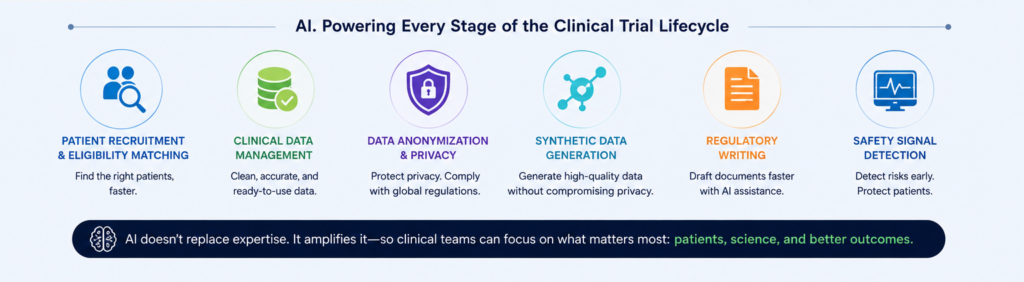
Patient Recruitment & Eligibility Matching
One of the most mature applications of AI in clinical research is matching patients to trials. Algorithms can scan electronic health records and trial protocols to identify eligible candidates far faster than manual screening, directly addressing one of the two biggest causes of trial delay and failure.
Clinical Data Management & Cleaning
AI-driven tools can automatically detect anomalies, flag missing data, and reconcile inconsistencies across data sources — reducing the manual burden on data management teams and improving the reliability of the resulting dataset.
Data Anonymization & Privacy Compliance
As disclosure requirements increase, sponsors need to publish clinical study reports and related documents while protecting patient privacy and commercially sensitive information. AI-powered anonymization tools can automatically detect and redact personally identifiable information and confidential commercial information (CCI) from clinical documents, a task that used to require weeks of manual review by legal and regulatory teams. GENINVO’s Shadow and Confidential Information Scanner (CIS) are built specifically for this use case, helping teams meet EMA Policy 0070, HIPAA, and GDPR requirements without slowing down submission timelines.
Synthetic Data Generation
Synthetic data artificially generated datasets that preserve the statistical properties of real clinical data without containing any actual patient information is increasingly used for secondary research, AI model training, and data sharing between organizations. It offers a way to unlock the value of clinical data for research and innovation while eliminating the privacy risk of working with real patient records. GENINVO’s Datalution platform is built around this exact capability.
Medical Writing & Regulatory Document Automation
Clinical study reports, protocols, and other regulatory documents are lengthy, highly structured, and subject to strict quality standards. AI tools can now assist with both drafting and quality control — flagging inconsistencies, formatting errors, and compliance issues that human reviewers might miss under time pressure. GENINVO’s DocQC and DocWrightAI apply AI to exactly these workflows, from quality control checks to first-draft document generation.
Statistical Programming Automation
Statistical programming much of it still done in SAS remains one of the most specialized and time-intensive parts of the trial analysis process. AI-assisted tools are beginning to automate repetitive programming tasks, letting statistical programmers focus on complex analysis rather than routine code generation. GENINVO’s CodeMagic is designed for this purpose.
Real-Time Monitoring & Decentralized Trials
With more trials incorporating wearables and remote monitoring, AI plays a growing role in processing continuous data streams, detecting safety signals in real time, and supporting the broader shift toward decentralized clinical trials.
Benefits of AI in Clinical Trials
The practical case for AI in clinical trials comes down to five recurring benefits reported across the industry:
- Faster timelines – automation of recruitment, data cleaning, and document review can meaningfully compress trial timelines
- Lower operational costs – less manual labor spent on repetitive administrative and compliance tasks
- Improved data quality – automated anomaly detection catches errors that manual review often misses
- Better patient-trial matching – reduces recruitment delays, one of the most common causes of trial failure
- Reduced compliance risk – automated anonymization and redaction lowers the risk of accidental disclosure of sensitive information
Challenges & Risks of AI in Clinical Trials
AI adoption in this space isn’t without friction, and it’s worth being clear-eyed about the challenges:
- Data privacy and regulatory compliance – AI systems that touch patient data must be built to the same privacy and security standards as the rest of the clinical data pipeline, not treated as an exception
- Explainability and governance – regulators and internal quality teams need to understand how an AI system arrived at a given output, particularly for anything that touches trial data integrity or safety signals
- Validation and adoption barriers – clinical research organizations move cautiously by design; new tools need to be validated against existing standards before they can be trusted for regulated workflows
- Integration with legacy systems – many sponsors and CROs run on established eClinical platforms, and any new AI tool needs to integrate cleanly rather than create a parallel, disconnected workflow
The organizations getting the most value from AI in clinical trials tend to be the ones treating it as a governed, embedded part of the research process not a bolt-on efficiency trick.
Regulatory Considerations: HIPAA, GDPR, and EMA Policy 0070
Any AI system touching clinical trial data has to operate within an already dense regulatory framework:
- HIPAA governs the protection of patient health information in the US
- GDPR sets strict rules for the processing of personal data for any trial involving EU participants
- EMA Policy 0070 requires sponsors to proactively publish clinical data for medicines authorized in the EU, with personal data and confidential commercial information anonymized and redacted before publication
This is precisely where AI-powered anonymization software earns its place not as a nice-to-have efficiency tool, but as a practical requirement for sponsors trying to meet disclosure obligations without diverting large teams to months of manual redaction work.
For this reason, regulatory compliance is often the deciding factor in how quickly an organization moves from evaluating AI in clinical trials to actually deploying it.
The Future of AI in Clinical Trials
Looking ahead, a few trends are likely to define the next phase of AI in clinical trials adoption:
- Agentic AI – systems that don’t just answer questions but can plan and execute multi-step workflows (e.g., preparing an entire document package for submission) are moving from research demos toward real operational use
- Adaptive trial design – AI-supported real-time analysis is enabling trials that can adjust in-flight based on interim results, rather than waiting for a fixed analysis milestone
- Deeper integration across the trial lifecycle – rather than isolated point tools, AI capabilities are increasingly being embedded across recruitment, data management, writing, and reporting as a connected system
- Continued regulatory evolution – as AI becomes more embedded in trial operations, expect more specific guidance from regulators on validation, explainability, and acceptable use
How GENINVO’s AI Software Supports Clinical Trials
GENINVO builds AI-powered software purpose-built for the operational realities of clinical research:
- Shadow & CIS – automated anonymization and CCI redaction for clinical documents
- Datalution – synthetic clinical data generation for research and model training
- DocQC & DocWrightAI – AI-assisted medical writing quality control and document generation
- CodeMagic – statistical programming automation for SAS-based workflows
- Data Collaboration – secure data sharing across trial teams and partners
Together, these tools address the recruitment-to-reporting lifecycle challenges outlined throughout this guide — helping pharmaceutical companies, biotechs, and CROs move faster while staying aligned with global compliance requirements.
Ready to see how AI software for clinical trials can fit into your workflow? Book a demo with GENINVO today.
FAQs
What is AI in clinical trials?
AI in clinical trials refers to the use of machine learning, natural language processing, and generative AI to support tasks across the trial lifecycle — including patient recruitment, data management, anonymization, medical writing, and statistical analysis.
How is AI used in clinical trial data management?
AI is used to automatically detect anomalies, clean and reconcile data from multiple sources, and flag inconsistencies reducing manual review time and improving overall data quality.
Is AI-generated synthetic data reliable for clinical research?
Synthetic data is designed to preserve the statistical properties of real clinical datasets without containing actual patient information, making it a reliable option for secondary research and AI model training when generated using validated methods.
What are the regulatory risks of using AI in clinical trials?
The main risks involve data privacy compliance (HIPAA, GDPR), explainability of AI-driven decisions, and ensuring any AI tool is properly validated before being used in regulated workflows.
Which companies provide AI software for clinical trials?
A number of companies offer AI-powered software for clinical trials, ranging from large eClinical platforms to specialized providers. GENINVO focuses specifically on AI-powered anonymization, synthetic data generation, medical writing automation, and statistical programming for life sciences organizations.