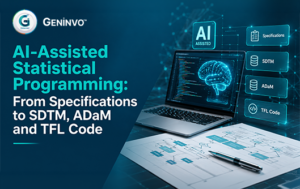
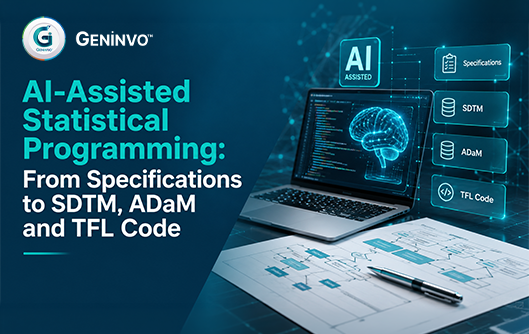
How AI is helping statistical programming teams move from specifications to smarter, more efficient programming workflows.
Statistical programming in clinical trials is becoming increasingly complex.
Today’s teams work across raw data specifications, SDTM specifications, CDISC Controlled Terminology, Understanding Statistical Analysis Plans (SAPs) and TFL mock shells, ADaM specifications, existing program repositories, and organization-specific programming standards.
All of these artifacts need to work together while maintaining quality, consistency, traceability, and demanding study timelines.
Traditionally, experienced statistical programmers have translated these requirements into programming logic and executable code manually.
Artificial intelligence is beginning to change that workflow.
AI can assist with ADaM specification generation and code generation for SDTM, ADaM, and Tables, Figures, and Listings (TFLs).
The opportunity is not to replace statistical programmers.
It is to give them an intelligent, context-aware way to generate high-quality specifications and programming code.
That is the vision behind CodeMagic, Geninvo’s AI-assisted statistical programming solution.
The Changing Landscape of Clinical Statistical Programming
Statistical programming in clinical trials is a connected lifecycle. Programming teams work with multiple specifications, standards, analysis requirements, and supporting artifacts to transform study data into standardized datasets and statistical outputs.

At each stage, statistical programmers interpret requirements, develop programming logic, write code, execute programs, review results, and perform QC and validation.
The process is well established, but it can also be time-consuming and repetitive, particularly when similar programming patterns, derivations, and organizational conventions need to be implemented across multiple datasets and studies.
This is where AI-assisted statistical programming creates an opportunity.
Rather than treating AI as a generic coding assistant, organizations can provide relevant study and programming context so that AI assistance is grounded in the requirements that define the intended output.
The objective is not to remove the programmer from the process. It is to give the programmer a more intelligent and context-rich starting point.
What Is AI-Assisted Statistical Programming?
AI-assisted statistical programming adds an intelligence layer to the traditional workflow by using specifications, standards, analysis requirements, mock shells, and organizational programming knowledge to generate high-quality specifications and code.

The key value is context-aware programming – translating requirements into solutions aligned with study and organizational standards.
This reduces repetitive programming effort while allowing statistical programmers to focus on review, QC/verification, complex requirements, and statistical and clinical judgment.
AI accelerates programming; experts provide the judgment and oversight.
Why Context Matters More Than Code Generation
There is an important difference between a general-purpose AI coding assistant and an AI system designed for statistical programming.
A general coding assistant may know how to write programming syntax.
A statistical programming team needs assistance that understands the context behind the code.
For example, organizations have their own:
- Programming conventions
- Naming standards
- Code structures
- Output formats
- QC practices
- Documentation approaches
- Analysis conventions
- Existing program repositories
These assets represent years of organizational programming knowledge.
When they become part of the AI context, the question changes from:
“How would AI write this program?”
to:
“How would our organization implement this requirement?”
CodeMagic is designed to use customer-specific programming repositories and standards as part of its programming context.
This helps generated specifications and code align with established organizational practices, programming conventions, and study requirements.
CodeMagic: The Future of AI-Assisted Statistical Programming
The evolution of statistical programming is not about replacing experienced programmers. It is about giving them intelligent tools that can use the growing body of specifications, standards, analysis requirements, and organizational programming knowledge already available within a study and an organization.
This is the vision behind CodeMagic.
CodeMagic is designed to help statistical programming teams move from specifications and analysis requirements to high-quality ADaM specifications and programming code for SDTM, ADaM, and TFL development.
Its capabilities include:
ADaM Specification Generation
Generate comprehensive ADaM specifications using relevant study context, SDTM information, analysis requirements, TFL mock shells, and organizational programming standards.
SDTM, ADaM and TFL Code Generation
Generate high-quality programming code by translating defined specifications and requirements into executable statistical programming solutions.
Customer-Specific Programming
Use existing program repositories, reusable functions, naming conventions, and organizational programming standards as important sources of programming context.
Context-Aware Programming
Connect specifications, standards, analysis requirements, and supporting artifacts so that generated specifications and code reflect the broader statistical programming context.
Human-in-the-Loop: Quality and Verification
Designed to assist – not replace – statistical programmers. Generated specifications and code are reviewed by programmers and subjected to the organization’s established QC and validation processes to ensure accuracy, consistency, and alignment with study requirements. This combination of CodeMagic’sAI capabilities and expert statistical programming judgment keeps quality and control at the center of the workflow.
Programming Language Agnostic
Support statistical programming across SAS, R, and other programming technologies by focusing on specifications, analysis requirements, standards, and organizational programming knowledge rather than a specific programming language.
Privacy-Conscious Programming
Support AI-assisted programming without requiring patient-level clinical data to be shared with the CodeMagic.
From specifications to code.
From repetitive programming to intelligent assistance.
From disconnected artifacts to a more connected statistical programming workflow.
That is the future CodeMagic is designed to enable.
Measuring Accuracy and Efficiency
AI-assisted statistical programming should be evaluated not only by how much code it can generate, but also by the quality and efficiency of the resulting programming workflow.
CodeMagic can be measured using key performance indicators such as specification accuracy, code accuracy, and programming efficiency.
Key Performance Metrics

The objective is not simply to generate code faster.
It is to generate high-quality programming solutions efficiently while maintaining expert review and control.
The Future: From Specifications to Smarter Statistical Programming
- Increasing complexity: Complex studies, evolving standards, and tighter timelines are driving the need for smarter programming.
- Beyond code generation: AI can make the context behind programming more accessible, reusable, and intelligent.
- Context-aware programming: CodeMagic connects specifications, standards, analysis requirements, and organizational programming knowledge.
- Practical impact: It helps translate defined requirements into high-quality ADaM specifications and SDTM, ADaM, and TFL code.
- The vision: CodeMagic enables a more connected, intelligent, and efficient statistical programming workflow.
Explore CodeMagic
If your organization is evaluating AI-assisted statistical programming for ADaM specification generation, SDTM, ADaM, or TFL development, discover how CodeMagic can fit into your existing programming workflow.
Explore CodeMagic / Book a Demo
Frequently Asked Questions
1. What is AI-assisted statistical programming?
AI-assisted statistical programming uses artificial intelligence to help programmers interpret specifications, generate programming structures and code, and reduce repetitive development work. Expert review, QC, and validation remain part of the workflow.
2. What does CodeMagic support?
CodeMagic is designed to support ADaM specification generation and AI-assisted code generation for SDTM, ADaM, and TFL development.
3. How is CodeMagic’s performance measured?
CodeMagic can be evaluated using metrics such as specification accuracy, code accuracy, and programming efficiency/time reduction. Performance can vary depending on study complexity, use case, source artifacts, and programming standards.
4. Does CodeMagic require patient-level data?
The CodeMagic approach is designed so that patient-level data does not need to be shared with the AI for programming assistance. Specifications, metadata, analysis requirements, mock shells, and programming standards can provide the development context.
5. Does AI replace statistical programmers?
No. AI assists with programming activities, while statistical programmers remain responsible for reviewing logic, validating outputs, performing QC, and applying statistical and clinical judgment.
6. Is CodeMagic tied to a specific programming language?
CodeMagic is designed with a language-agnostic approach, focusing on statistical programming requirements and organizational context rather than a single programming language.
Written by Amit Satra, Director – Statistical Programming